

close
Choose Your Site
Global
Social Media


Views: 0 Author: Site Editor Publish Time: 2026-11-16 Origin: Site


Manual measurement errors drain profitability. Traditional cabinetry often generates massive material waste. Workers suffer from physical fatigue, which inevitably drags down production timelines. Fortunately, the woodworking landscape is shifting. Automation is no longer a luxury; it is the baseline standard. A cabinet making CNC router bridges digital precision and physical craftsmanship. It solves these perennial shop floor problems head-on. Below, we detail how automated routing transforms quality, accelerates throughput, and slashes operational costs.
Woodworking history relies heavily on manual labor. Artisans spent centuries mastering hand planes and chisels. Mechanized table saws eventually sped up the process. Yet, human inconsistency remained a severe bottleneck. The real manufacturing leap originated in aerospace engineering. Computer Numerical Control technology was built for absolute repeatability. Adapting this technology for timber fundamentally altered shop floor dynamics.
Modern systems operate lightyears ahead of early rudimentary setups. Today, mid-sized custom shops rely on advanced routing to survive in a hyper-competitive market. Precision is no longer optional. It is the core requirement for scaling a cabinet business.
Translating CAD designs into physical perfection drives modern cabinetry. Automated routing upgrades output quality across the board. Pinpoint accuracy forms the baseline. Tape measures inherently invite human error. Conversely, automated systems operate on a rigid digital coordinate grid. They hold tolerances within fractions of a millimeter. Every cabinet box and drawer front perfectly matches the digital model. Assembly becomes seamless. Unsightly gaps disappear.
Complex joinery also becomes standard practice. Blind dados, dowel holes, and mortise-and-tenon joints require exact depth control. The machine executes these cuts flawlessly. This precision creates a perfect surface for edge banding. Adhesives bond securely without delamination risks.
Custom work no longer halts production. Arched panels and intricate hardware cutouts used to demand tedious template creation. Now, the spindle moves along multiple axes simultaneously. It carves complex patterns as efficiently as a standard rip cut.
Machine consistency eliminates the fatigue factor. Manual labor quality drops at the end of a long shift. An automated spindle never tires. A panel cut on Friday afternoon matches the exact precision of a Monday morning run.
Surface finish improves drastically. High-speed spindles optimize chip load based on material density. This prevents tear-out on delicate veneers. Consequently, workers spend significantly less time on labor-intensive sanding stages.
Profitability hinges on efficiency. Nested-based manufacturing streamlines workflows. It allows shops to scale volume without expanding the payroll. Nesting software acts as a digital puzzle master. It arranges cabinet components across a single sheet of plywood. A cabinet making CNC router then processes these parts in one continuous cycle. This eliminates hours of manual material handling.
Production Metric | Traditional Woodworking | CNC Nested Manufacturing |
|---|---|---|
Setup Time | Multiple setups across different machines | Single setup for cutting and drilling |
Material Yield | 70% to 80% utilization | 90% to 95% utilization |
Labor Required | 2 to 3 skilled operators | 1 operator |
Machining Accuracy | Subject to human error and fatigue | Strict 0.05mm tolerance |
Consolidating steps adds immense value. Legacy woodshops move panels from a saw to a boring machine, then to a shaper. Advanced systems equipped with an Automatic Tool Changer handle sizing, hinge drilling, and edge profiling in a single setup. Small teams can now execute large commercial contracts profitably.
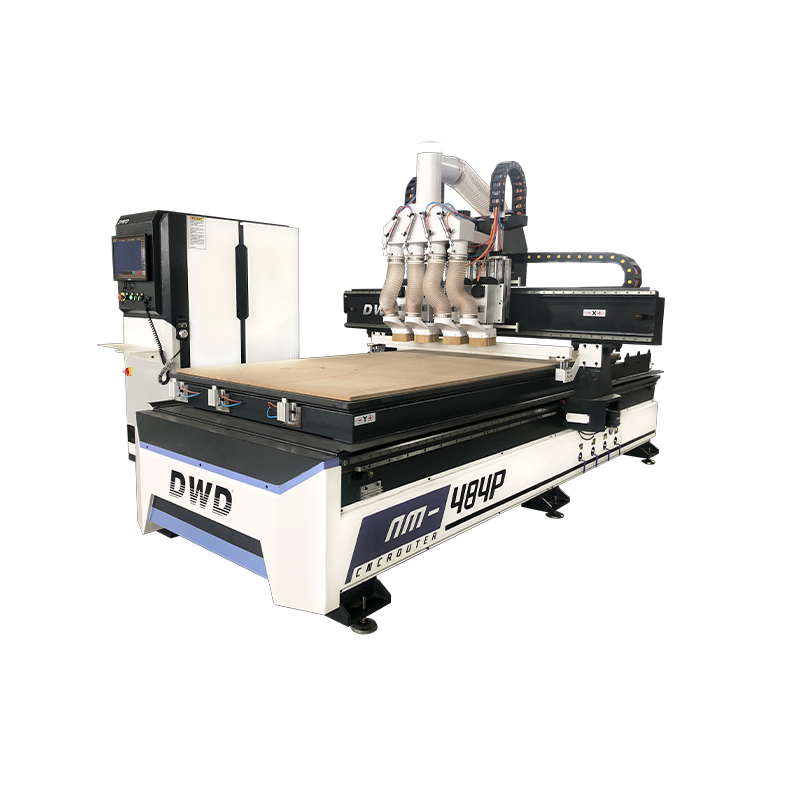
Raw materials consume a massive portion of overhead. Traditional crosscutting generates excessive scrap. Algorithmic nesting changes the math entirely. The software calculates the tightest possible part arrangement on a standard sheet. Interlocking pieces minimize offcuts. Material yield skyrockets compared to manual cutting.
Machine precision also eradicates miscut panels. Dumpsters no longer fill up with expensive mistakes. Extracting more usable components from every sheet directly improves project profit margins. Furthermore, minimizing sheet goods consumption lowers the overall environmental impact of your shop.
The woodworking sector is rapidly shifting toward data-driven production. Recent industry analysis highlights a massive surge in software-to-machine integration. Shops are moving away from isolated machines. Instead, they adopt interconnected ecosystems. AI-driven nesting algorithms now generate machine-ready toolpaths directly from 3D room renderings. This completely bypasses manual programming.
Automated material handling is another dominant trend. Scissor lift tables and vacuum sweeping arms load and unload heavy melamine sheets. This removes severe physical strain from operators. As these technologies mature, mid-sized shops are inching closer to lights-out manufacturing. Machines sustain high-speed production with minimal human intervention. Staying competitive now requires embracing this digital workflow.
Selecting equipment demands a balance of current capacity and future growth. You need specific hardware configurations to handle high-production nested manufacturing. A robust vacuum table is non-negotiable. It secures warped panels flat during aggressive routing. An Automatic Tool Changer maximizes spindle uptime.
Consider the engineering behind a professional cabinet making CNC router. Look for industrial-grade components. A 9kW high-frequency air-cooled spindle provides the torque needed for single-pass cuts through dense MDF. A 12-position linear tool changer swaps bits in seconds. High-torque servo motors ensure rapid positioning without losing steps. Heavy-duty steel frames absorb vibration, guaranteeing clean edge finishes. While the initial capital investment seems significant, the return on investment typically materializes within 12 to 24 months. Material savings and labor efficiency compound rapidly.
Transitioning your shop requires strategic infrastructure planning. Upgrade your software library before the machine hits your loading dock. Operators must master design programs early. Facility infrastructure also needs attention. Verify your 3-phase power capacity. Install a high-CFM dust collection system to handle the massive volume of chips generated.
Frame this technology as a skill multiplier for your staff. When workers view the machine as a tool to elevate their craft, morale improves. Production precision follows suit. A well-integrated system transforms a chaotic shop into a predictable manufacturing environment.
Prices range significantly based on build quality, spindle power, and automation features. Entry-level professional units often start around $15,000. High-volume industrial machines can exceed $100,000. The return on investment is usually rapid due to the elimination of material waste and the reduction in manual labor costs.
Not at all. You operate the machine using user-friendly CAD/CAM software. The software automatically translates your designs into the necessary machine code. Managing the digital design interface is the only requirement to command the machine to perform complex tasks.
For a standard 4x8 or 5x10 machine, plan for a footprint of at least 15x20 feet. This ensures adequate room for loading raw material and pulling off finished parts. It also maintains clear pathways for operator safety around the moving gantry.
Yes, these machines are incredibly versatile. Beyond standard plywood and MDF, they machine plastics, acrylics, and melamine. They also handle soft non-ferrous metals like aluminum. This versatility allows shops to expand into commercial retail displays and unique architectural elements.
The ideal software depends on your specific workflow. Cabinet Vision and Mozaik are industry standards for full-scale cabinetry design and automatic nesting. VCarve Pro is excellent for general routing and custom 2D/3D parts. Ensure your chosen software integrates seamlessly with your machine controller.
Basic operation takes a few days of hands-on training. Operators quickly learn how to load material, set tool zero points, and run pre-programmed files. Mastering the design software and optimizing toolpaths typically takes a few months of consistent practice. Manufacturer support and online tutorials greatly accelerate this learning curve.
Ready to eliminate production bottlenecks and scale your cabinetry business? Upgrading your shop floor with industrial-grade automation is the most effective path to higher profit margins. Evaluate your current production volume and explore tailored solutions. Visit DWD CNC to find the exact cabinet making CNC router that fits your manufacturing needs and start transforming your workflow today.

