close
Choose Your Site
Global
Social Media

Views: 0 Author: Site Editor Publish Time: 2026-05-05 Origin: Site
A CNC Router improves furniture design and manufacturing by converting digital drawings into precise cutting, drilling, grooving, carving, and nesting operations, helping furniture producers create accurate parts, improve production speed, reduce waste, and support both custom orders and mass production.
This is why the CNC Router is widely used in modern woodworking and furniture production. It helps designers create complex shapes more freely, allows manufacturers to process panels more efficiently, and gives businesses a practical way to handle more orders without relying only on skilled manual labor.
The following guide explains what a CNC Router is, how it is used in furniture design, why it matters in furniture manufacturing, how it supports the full process from prototype to mass production, and how it contributes to sustainability and waste reduction.
Section | Summary |
|---|---|
What Is a CNC Router? | Explains the basic function of a CNC Router, how it reads digital files, and why it is suitable for woodworking and panel furniture production. |
Furniture Design Applications of CNC Routers | Covers common furniture applications such as cabinets, wardrobes, doors, decorative panels, customized shapes, drilling, grooving, and nesting. |
Benefits of Using CNC Routers in Furniture Manufacturing | Describes advantages such as precision, efficiency, repeatability, labor savings, design flexibility, and improved production management. |
From Prototype to Mass Production | Shows how a CNC Router helps furniture manufacturers test designs, revise prototypes, and scale into stable batch production. |
Sustainability and Waste Reduction | Explains how nesting, optimized cutting paths, fewer production errors, and digital control help reduce material waste and improve resource use. |
A CNC Router is a computer controlled cutting and shaping machine that uses digital design files to process materials such as wood, MDF, plywood, particle board, acrylic, plastic, and composite panels with high accuracy and repeatability.
A CNC Router works by following tool paths generated from CAD and CAM software. Instead of depending on manual measurement for every cut, the operator prepares or imports a digital design, converts it into machine readable instructions, and allows the CNC Router to move the cutting tool across the workpiece. This process can include cutting, engraving, carving, grooving, drilling, profiling, and nesting, depending on the machine configuration and the production requirement.
In furniture manufacturing, the CNC Router is especially useful because many furniture parts require repeatable dimensions. Cabinet side panels, shelves, door panels, drawer fronts, back panels, table components, decorative boards, and modular furniture parts must match accurately during assembly. If one panel is cut incorrectly, the final furniture may have poor alignment, visible gaps, weak structure, or installation problems. A CNC Router helps reduce these issues by turning digital dimensions into consistent physical parts.
A modern CNC Router can be used in small workshops as well as large furniture production lines. In a small furniture studio, a CNC Router may help produce customized items, decorative surfaces, unique shapes, and low volume orders. In a larger panel furniture factory, a CNC Router can become part of an integrated production system with automatic loading, unloading, labeling, drilling, edge banding, and central control. This makes the CNC Router suitable for flexible manufacturing as well as industrial scale furniture production.
Step | Production Action | Purpose in Furniture Manufacturing |
1 | Create or import a design file | Converts furniture concepts into digital dimensions and shapes. |
2 | Generate tool paths | Defines how the CNC Router cuts, drills, grooves, or engraves the material. |
3 | Fix the material on the table | Holds wood panels or boards firmly for stable machining. |
4 | Start machining | The CNC Router processes parts according to the programmed path. |
5 | Remove and inspect parts | Finished parts are checked before assembly, edge banding, sanding, or finishing. |
A CNC Router is also valuable because it can process repeat orders more easily. Once a furniture design is programmed and tested, the same digital file can be used again. This is important for cabinet manufacturers, hotel furniture suppliers, office furniture producers, and panel furniture factories that need consistent quality across multiple projects. Compared with manual routing, the CNC Router reduces the chance of human measuring mistakes and improves the stability of production results.
For many furniture companies, the CNC Router is the foundation of digital manufacturing. It bridges the gap between design and production. Designers can create parts in software, production teams can process those parts with controlled accuracy, and managers can organize workflows based on more predictable cutting time and output. This makes the CNC Router a practical investment for factories that want to improve both product quality and production efficiency.
A CNC Router is used in furniture design to cut panels, create custom shapes, engrave decorative surfaces, drill assembly holes, groove parts, process cabinet components, and support personalized furniture production.
Furniture design often requires a balance between appearance, function, production cost, and assembly accuracy. A CNC Router helps designers and manufacturers achieve this balance because it can process both simple straight cuts and more complex curved or decorative shapes. For example, a CNC Router can cut cabinet panels to size, create door profiles, engrave decorative patterns, prepare hinge positions, open hardware holes, and shape curved furniture elements.
One of the most common CNC Router applications is cabinet and wardrobe production. Cabinet furniture usually involves many panels with repeated dimensions, including side panels, partitions, doors, backs, shelves, and drawer parts. A CNC Router can process these panels according to a digital cutting plan, making it easier to maintain consistent sizes across an entire order. In cabinet production, a machine such as a multi spindle cabinet production CNC Router can be especially useful because the product information describes four 6.0 kW spindles, an all steel structure, precision linear rails and bearings, a servo system with reducer, and a standard automatic unloading function for panel furniture production.
A CNC Router is also useful for customized furniture. Customers increasingly want furniture that fits a specific room, style, storage need, or interior layout. Manual customization can be time consuming and inconsistent, especially when many parts must be adjusted. With a CNC Router, designers can modify dimensions in the digital file and then produce parts according to the revised design. This makes custom wardrobes, kitchen cabinets, wall panels, display cabinets, reception desks, and commercial fixtures easier to manufacture.
Furniture Part | CNC Router Processing Method | Typical Benefit |
Cabinet side panels | Cutting, drilling, grooving | Accurate assembly and better repeatability. |
Door panels | Profiling, engraving, edge shaping | More design freedom and decorative value. |
Shelves and partitions | Straight cutting and hole drilling | Consistent size and easier installation. |
Drawer components | Cutting and grooving | Improved fit between parts. |
Decorative screens | Carving and pattern cutting | Supports creative design and visual detail. |
Table components | Profiling and shaping | Smooth curves and repeatable production. |
Modular panels | Nesting and drilling | Better material use and faster batch output. |
In panel furniture production, nesting is another important CNC Router application. Nesting means arranging multiple parts on one board to maximize material use and reduce offcuts. A nesting CNC Router can cut many parts from one sheet according to an optimized layout. This is important for manufacturers working with MDF, plywood, particle board, and other sheet materials because board cost can represent a major part of total production cost.
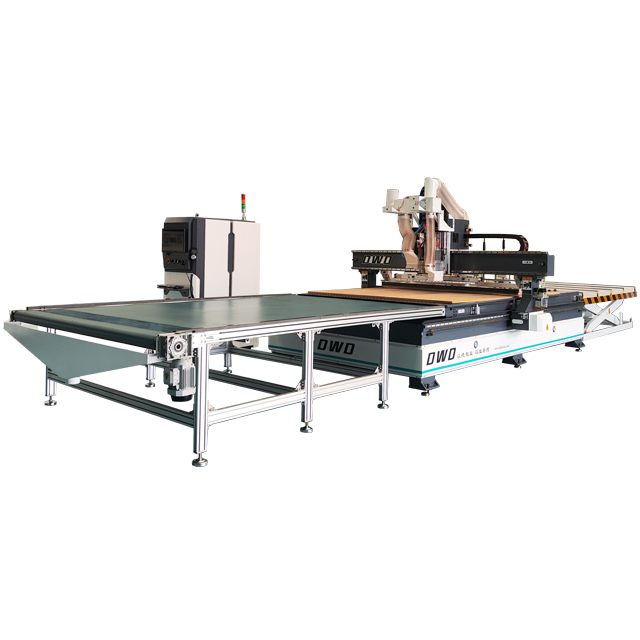
A more automated solution, such as an intelligent nesting CNC Router production cell, can connect automatic labeling, loading and unloading ATC nesting machines, a power drum line, and a central control system. The product information describes a workflow where the operator places boards on a lifting platform, the labeling system labels the board automatically, and the central control system assigns the board to the nesting center for cutting. This kind of CNC Router setup is suitable for manufacturers that need a more organized workflow for large scale and customized panel furniture production.
Cabinets and wardrobes depend on accurate panel dimensions. A CNC Router can cut side panels, shelves, bottom panels, tops, backs, doors, and drawer parts according to the design file. It can also prepare grooves for back panels and drilling positions for connectors. This reduces manual layout work and helps each furniture set assemble more smoothly.
A CNC Router can create decorative grooves, carved patterns, texture lines, relief effects, and shaped edges. This is useful for furniture designers who want to add visual detail without depending entirely on manual carving. For interior furniture, decorative doors, wall panels, and commercial display units, a CNC Router helps turn creative patterns into repeatable production results.
Many furniture buyers want special sizes or personalized designs. A CNC Router allows manufacturers to adjust digital files quickly, process new dimensions, and produce small batches with controlled accuracy. This makes the CNC Router suitable for custom kitchens, retail displays, hotel furniture, office furniture, and built in storage solutions.
The main benefits of using a CNC Router in furniture manufacturing include higher precision, faster production, better repeatability, reduced labor dependence, more flexible design, improved material utilization, and easier production management.
Precision is one of the strongest reasons furniture manufacturers use a CNC Router. Furniture parts must fit together correctly, especially in cabinet making and panel furniture production. If the cutting size, drilling position, or groove depth is wrong, the final assembly may require rework. A CNC Router helps avoid these problems by following programmed tool paths and keeping consistent machining results across repeated parts.
Efficiency is another major benefit. Manual cutting, marking, drilling, and shaping can take a long time, especially when many panels are involved. A CNC Router can complete many of these processes on one machine. In a cabinet shop, this means panels can move from digital design to machining more directly. In a larger factory, the CNC Router can be connected with other production equipment to form a more automated workflow.
Repeatability is essential for B2B furniture manufacturing. A furniture company may need to produce the same cabinet model for multiple apartments, offices, hotels, schools, or retail spaces. A CNC Router allows the same file to be processed repeatedly with stable results. This reduces variation between batches and helps companies maintain consistent product quality.
Benefit | Manual Processing Challenge | CNC Router Advantage |
Precision | Measurements may vary by operator | Digital control improves dimensional consistency. |
Speed | Cutting and drilling are often separate steps | A CNC Router can combine multiple processes. |
Repeatability | Repeated parts may not match perfectly | The same program can produce consistent parts. |
Labor use | Requires skilled manual layout and routing | Operators can manage machine based workflows. |
Design flexibility | Complex shapes take more time | Curves, grooves, and patterns can be programmed. |
Material use | Manual cutting may create more offcuts | Nesting software improves board layout. |
Production control | Harder to track each part | Digital files and labeling improve organization. |
Panel furniture depends on clean and accurate machining. A CNC Router can cut panels to required dimensions, prepare holes for connectors, and create grooves for assembly. This helps furniture makers reduce gaps, misalignment, and installation problems. For cabinet production, a CNC Router with precision rails, stable transmission, and suitable working size can support more reliable output.
The cabinet making CNC Router for panel furniture shops is described with a 1220 by 2440 by 150 mm working size for one model and a 1220 by 2800 by 150 mm working size for another model in the same series. It also lists rack and pinion transmission for X and Y axes, a ball screw for the Z axis, a 50 m per minute travelling speed, and a 20 m per minute working speed. These details show how a CNC Router can be configured for practical cabinet and panel production.
A CNC Router improves efficiency by reducing repeated manual operations. Instead of measuring each board by hand, marking cutting lines, moving parts between several machines, and adjusting tools manually, the operator can prepare a production file and process parts with a controlled workflow. This can shorten lead time, especially for furniture orders with many panels.
Efficiency becomes even more important when a factory handles mixed orders. A CNC Router can process different part shapes and sizes as long as the digital files are prepared correctly. This makes it possible to produce customized furniture without completely interrupting the production system.
Skilled workers are still important in furniture manufacturing, but a CNC Router reduces the need for every process to depend on manual measuring and cutting ability. Operators can focus on file preparation, machine setup, tool selection, material handling, and quality checking. This makes training more manageable and helps factories maintain output even when labor conditions change.
A CNC Router gives furniture designers more freedom because complex patterns and shapes can be programmed. Curved panels, decorative doors, engraved surfaces, shaped partitions, and custom fixtures can be produced more efficiently than with purely manual work. This allows furniture businesses to offer more design options to customers.
Quality control improves when production becomes more measurable. A CNC Router creates parts based on defined files and tool paths. If the result needs improvement, the file, tool, feed rate, or machining strategy can be adjusted. This makes improvement more systematic compared with manual production where errors may come from different operator habits.
A CNC Router supports the full furniture production journey by helping manufacturers create prototypes, test fit and structure, revise designs, confirm production files, and then scale the same design into repeatable batch or mass production.
Furniture development often begins with a design idea. Before mass production, the manufacturer needs to test whether the dimensions, assembly method, hardware positions, appearance, and material use are practical. A CNC Router helps speed up this stage because the first prototype can be produced directly from the design file. If the prototype needs adjustment, the designer can revise the file and produce the next version without rebuilding the whole process manually.
During prototyping, a CNC Router is useful for checking the fit between panels. For example, a cabinet design may need accurate holes for hinges, grooves for back panels, and connector positions for shelves. A CNC Router can create these features in the prototype so the manufacturer can evaluate assembly before committing to batch production. This reduces the risk of discovering design problems after many parts have already been cut.
Once the prototype is approved, the same CNC Router program can be used for production. This is one of the main reasons the CNC Router is valuable for furniture manufacturing. The transition from prototype to mass production becomes smoother because the production file has already been tested. Manufacturers can also store the file for future repeat orders, making it easier to serve long term customers.
Stage | CNC Router Role | Result |
Design concept | Converts drawings into machine ready files | Faster movement from idea to sample. |
Prototype machining | Cuts and drills sample parts | Tests structure, appearance, and assembly. |
Design revision | Adjusts file dimensions or machining details | Reduces trial and error costs. |
Production confirmation | Finalizes tool paths and material layout | Creates a repeatable production standard. |
Batch manufacturing | Produces multiple sets with the same file | Improves consistency and order fulfillment. |
Repeat order | Reuses approved programs | Shortens preparation time for future orders. |
A CNC Router also helps manufacturers manage different production volumes. For one custom project, the CNC Router can produce a limited number of parts with special dimensions. For a larger project, the same machine can process repeated components. For a complete panel furniture factory, a CNC Router can work as part of an integrated line that includes labeling, nesting, drilling, edge banding, and assembly preparation.
When production volume increases, automation becomes more important. A single CNC Router may be enough for small scale custom work, but factories with higher output may need automatic loading and unloading, labeling, central control, and multiple machines working together. An automated nesting CNC Router system for panel furniture can support this direction because the product page describes automatic labeling, two automatic loading and unloading ATC nesting machines, a power drum line, and a central control system. It also states that the system can process approximately 230 to 260 panels in 8 hours, depending on production conditions.
A CNC Router allows furniture makers to test design ideas quickly. Instead of preparing jigs and manual templates for every new design, the manufacturer can create a digital file and machine a prototype. This is useful for custom furniture, new cabinet models, decorative panels, and commercial furniture projects.
If a prototype does not fit correctly, the design can be revised in software. Hole positions, panel sizes, groove depths, and edge profiles can be adjusted before the next machining run. A CNC Router makes this revision process more controlled and traceable.
Once the design is finalized, the CNC Router can repeat the same cutting and drilling program. This helps factories produce multiple furniture sets with similar quality. It also helps project based furniture suppliers maintain consistency across different rooms, buildings, or customer locations.
When furniture production uses digital files, it becomes easier to organize projects by job number, material type, design version, and production batch. A CNC Router supports this digital workflow and helps manufacturers reduce confusion between similar parts.
A CNC Router supports sustainability in furniture manufacturing by improving material utilization, reducing cutting mistakes, optimizing nesting layouts, lowering rework, and helping factories use panels more efficiently.
Material waste is a major issue in furniture production. Wood panels, MDF, plywood, and particle board represent a significant cost for manufacturers. If panels are cut inefficiently, too much material becomes offcut waste. A CNC Router helps reduce this problem through nesting software and optimized cutting paths. By arranging parts more intelligently on each board, manufacturers can use a higher percentage of the material.
Waste reduction also comes from better accuracy. Manual errors can create unusable panels, wrong hole positions, damaged edges, or parts that do not fit during assembly. Every rejected part wastes material, time, labor, and energy. A CNC Router helps reduce these losses by following controlled tool paths and producing more consistent results.
In panel furniture production, labeling and digital part management can further reduce mistakes. When parts look similar, workers may mix them up during assembly. A production cell with automatic labeling can identify parts earlier in the process. This helps improve traceability and reduces the chance of incorrect assembly or missing components.
Waste Source | Cause in Traditional Production | CNC Router Solution |
Panel offcuts | Poor cutting layout | Nesting optimization improves board use. |
Incorrect parts | Manual measurement or marking mistakes | Digital files improve cutting accuracy. |
Assembly errors | Similar parts are mixed together | Labeling and digital management improve identification. |
Rework | Holes, grooves, or edges are wrong | Programmed machining improves repeatability. |
Labor waste | Repeated manual steps take more time | A CNC Router combines multiple operations. |
Material damage | Excessive handling between machines | Automated workflows reduce unnecessary movement. |
Nesting is one of the most direct ways a CNC Router reduces waste. Instead of cutting one part at a time without an optimized plan, nesting software arranges many parts on a single board. The CNC Router then follows that layout to cut the parts efficiently. This is especially useful for cabinet and panel furniture production, where many rectangular and irregular parts must be cut from standard boards.
A CNC Router reduces material waste by lowering the chance of repeated manual mistakes. Once the correct production file is confirmed, the machine can repeat the same process. This helps prevent wrong cuts, misplaced holes, and inconsistent grooves. For manufacturers, fewer errors mean less scrap and less time spent correcting avoidable problems.
Sustainability is not only about material. It also involves labor efficiency, machine time, and production flow. A CNC Router can combine cutting, drilling, grooving, and engraving in one controlled process. This reduces unnecessary movement between different workstations and can improve the overall efficiency of the furniture production line.
Traditional mass production can create inventory waste when furniture is produced before customers actually need it. A CNC Router supports made to order and customized production because digital files can be adjusted for specific orders. This helps furniture companies produce closer to actual demand, reducing the risk of unused inventory and excess material consumption.
For larger factories, sustainability also depends on process control. A smart CNC Router production cell with a central control system can optimize cutting programs, reduce plate waste, monitor production, and support continuous operation. When the production process is easier to monitor, managers can identify bottlenecks, reduce idle time, and improve material planning.