close
Choose Your Site
Global
Social Media

Views: 0 Author: Site Editor Publish Time: 2026-09-02 Origin: Site
Purchasing commercial production equipment represents a massive capital expenditure for any woodworking business. The ultimate goal extends far beyond merely cutting wood panels at higher speeds. You want to completely eliminate production bottlenecks and drastically improve your unit economics.
Transitioning from manual sliding table saws to automated systems presents significant operational challenges. Many shop owners struggle to accurately evaluate machine specifications, integrate complex design software, and estimate realistic production timelines. High-pressure sales pitches often promise exaggerated returns, leaving buyers confused about what matters most.
This comprehensive guide breaks down the essential criteria for upgrading to nested-based manufacturing. You will learn how to evaluate physical hardware limits, ensure seamless CAD/CAM compatibility, and manage adoption timelines effectively. We reveal the unvarnished technical realities behind a successful implementation, helping you make a profitable, long-term machinery investment.
Volume Dictates Specs: The choice of a cabinet making cnc router should be reverse-engineered from your daily sheet yield and material types (e.g., MDF, plywood, melamine).
Software is the True Engine: Even premium hardware bottlenecks if your CAD/CAM software doesn't generate efficient nesting and clean G-code.
Total Cost of Ownership (TCO) > Purchase Price: True ROI calculations must include facility upgrades (3-phase power, dust collection), tooling, and operator training.
Hold-Down is Critical: Vacuum pump capacity is the most common failure point for shops cutting standard or warped cabinet materials.
Success means more than just faster cutting speeds. When you integrate a Cabinet making cnc router into your facility, you must track measurable operational improvements. Look for a steep reduction in scrap rates. Monitor how automation decreases costly assembly errors. Furthermore, this transition lowers your dependency on highly specialized manual labor. You can shift skilled workers to custom finishing tasks rather than repetitive part sizing.
Avoid optimistic vendor calculations. Calculate your payback period by comparing actual labor savings against your monthly lease or finance costs. Most successful shops experience a standard 12-to-18-month adoption curve. During the first few months, production might even slow down slightly. You need this adjustment period to refine your toolpaths and train your operators. True profitability emerges once your team fully commands the new automated processes.
Automation fundamentally alters how materials move through your shop. Compare the two workflows below to understand the operational shift.
Legacy Workflow: Operators push sheets through a panel saw. Parts move to the edgebander. Finally, workers manually drill boring holes and route dadoes. This requires multiple setups and increases handling time.
Automated CNC Workflow: You load full sheets onto the machine bed. The router executes nested sheet cutting. It handles sizing, blind dadoes, and line boring in a single setup. Parts then go directly to the edgebander and straight into final assembly.
A heavy, welded steel frame is absolutely non-negotiable. Industrial routers face immense physical stress during rapid directional changes. Lightweight bolt-together frames suffer from micro-vibrations. These vibrations ruin the edge-finish quality, especially on brittle materials like melamine. A massive, stress-relieved steel gantry absorbs these forces. It ensures your Cnc Router Machine delivers chip-free edges pass after pass.
Your spindle serves as the heart of the cutting operation. Cabinetry generally requires robust ISO30 or HSK63 spindles. You should look for power ratings between 9HP and 12HP. This ensures you can push compression bits through 3/4-inch plywood in a single pass.
Additionally, an Automatic Tool Changer (ATC) is mandatory for nested-based manufacturing. Cabinet parts require multiple operations per sheet. You need profile cutting, 5mm shelf pin drilling, and hinge cup boring. A linear or carousel ATC switches these tools in seconds. Without an ATC, manual tool changes will destroy your production efficiency.
Even the best spindle cannot cut a moving target. Vacuum pump capacity represents a common failure point for many shops. You must size your vacuum pump correctly to prevent part movement during aggressive cuts. Rotary vane pumps work well for most standard operations. Liquid ring pumps offer exceptional hold-down power for highly warped materials. High-flow vacuum systems secure small cabinet parts securely against the MDF spoilboard.
Drive mechanics determine the repeatable accuracy of your machine. X and Y axes typically utilize helical rack and pinion systems. This setup provides rapid travel speeds across large table areas. Conversely, the Z-axis requires a precision ball screw. The ball screw maintains exceptionally tight tolerances. You need this vertical accuracy for cutting perfect blind dadoes and precise hinge cup depths.
A major industry pitfall occurs when machines and design software fail to communicate smoothly. You can buy the most robust hardware available. However, it becomes useless if your office software cannot send accurate instructions to the shop floor. Bridging this gap requires careful software selection before the machine ever arrives.
Your CAD platform dictates how quickly you can design a kitchen and generate cut lists. You must evaluate machine compatibility with industry-standard programs. Popular options include Cabinet Vision, Mozaik, Microvellum, and Pro100. These parametric platforms allow you to stretch cabinet sizes instantly. They update all joinery rules and part dimensions automatically. Ensure your chosen hardware vendor natively supports your preferred CAD environment.
Once you finish a design, the CAM software takes over. Its primary job is maximizing material efficiency. It uses true-shape nesting algorithms to arrange parts tightly on a sheet. This dramatically increases your sheet yield and reduces expensive material waste. The CAM software also auto-generates efficient toolpaths. It calculates the fastest route for the spindle, minimizing unnecessary travel time between cuts.
The post-processor acts as the vital translator between your CAM software and the machine controller. It converts digital toolpaths into machine-specific G-code. A generic post-processor often causes unpredictable machine behavior. You need a verified, bug-free post-processor. It ensures the spindle turns on, the vacuum activates, and the correct tools load without manual intervention.
Automated machinery requires significant physical infrastructure. You must evaluate your shop footprint carefully. Account for the machine dimensions, safety perimeters, and loading zones. Forklift access is critical for loading material bunks near the machine bed. Furthermore, these machines demand stable 3-phase power. You will also need a reliable, moisture-free compressed air supply to operate the ATC and pneumatic pop-up pins.
Traditional machinery dust collection falls short for nested manufacturing. CNC routing generates massive volumes of fine dust and heavy chips very quickly. You require significantly higher CFM (Cubic Feet per Minute) capacity. Inadequate dust extraction leads to premature tool wear. It also fouls the linear tracking rails and ruins the vacuum hold-down grip. Upgrading your central dust collector is often a mandatory step.
Consumables require a dedicated monthly budget. Standard carbide bits wear out quickly on engineered panels. You must budget for high-quality compression bits. For cutting abrasive melamine, diamond tooling (PCD) offers superior longevity. Additionally, you will regularly consume MDF sheets for your spoilboard. The machine must surface this MDF frequently to maintain a perfectly flat cutting plane.
Do not expect peak production on day one. You must plan for a 30-to-90-day productivity dip. During this initial phase, you will face software setup hurdles. Tooling calibration takes patience and trial runs. Operator training requires focused time away from normal production. Prepare your production schedule for this adjustment period to avoid missed client deadlines.
Machine Specification Framework Based on Volume
Production Level | Sheet Volume (Weekly) | Recommended Footprint | Key Features Needed | Best Application |
|---|---|---|---|---|
Entry-Level Commercial | 10 - 30 Sheets | 4x8 feet | Standard vacuum, entry-level ATC | Custom, low-volume architectural millwork |
Mid-Market Production | 30 - 100 Sheets | 5x10 feet | High-flow vacuum, heavier gantry, drilling block | Standard frameless/face-frame cabinet shops |
Industrial Automation | 100+ Sheets | Custom / Oversized | Auto-loading tables, labeling machines, multi-spindle block | High-volume commercial cabinetry |
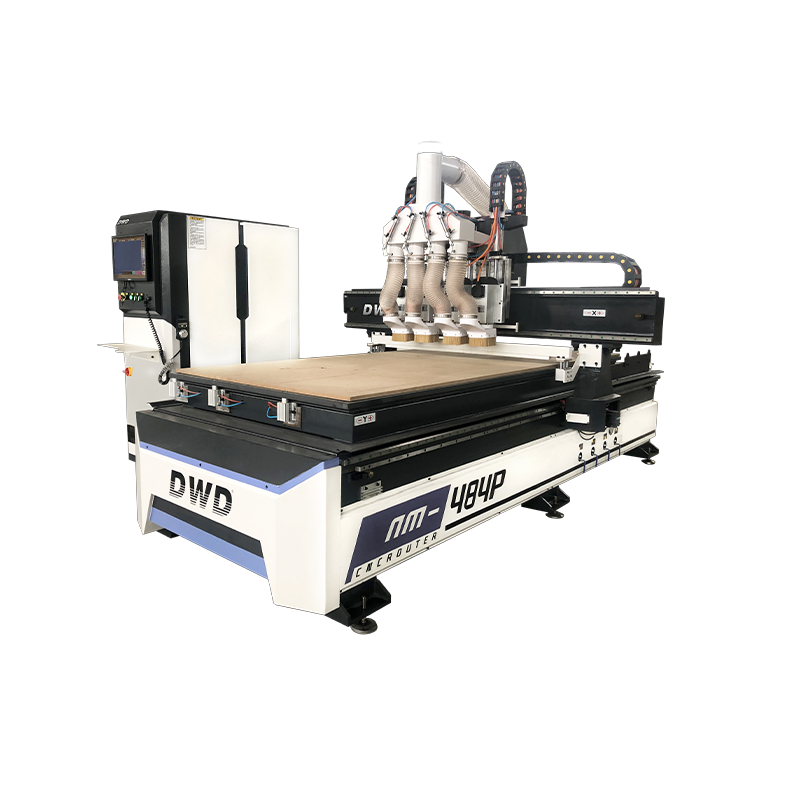
Small shops benefit greatly from a standard 4x8 footprint machine. These models feature a basic vacuum system and an entry-level linear ATC. They offer a highly accessible entry point into automation. This tier is best suited for custom builders focusing on low-volume architectural millwork. You gain precision without over-investing in unnecessary speed.
Growing cabinet shops need more robust capabilities. A 5x10 footprint allows you to process oversized sheets easily. You will need a high-flow vacuum system to hold parts aggressively. A heavier gantry prevents vibration at higher feed rates. Crucially, this tier introduces the drilling block (boring head). A boring block dramatically accelerates the production of standard frameless or face-frame cabinetry.
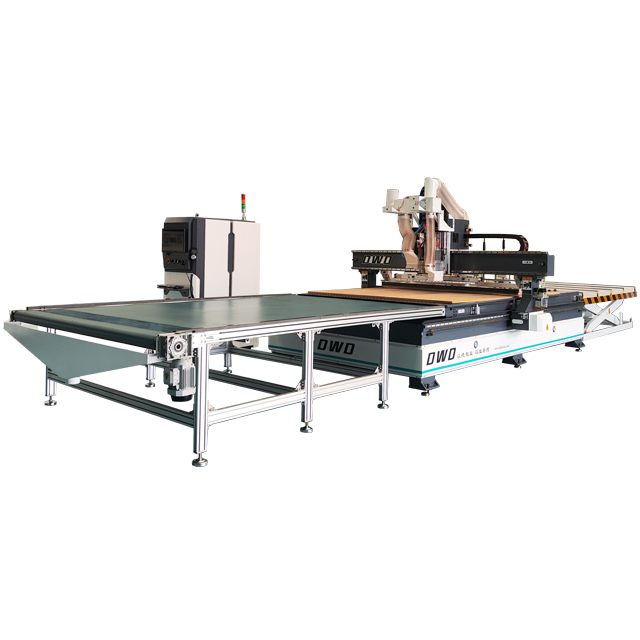
High-volume operations demand continuous throughput. Machines in this category remove manual material handling entirely. They feature auto-loading and unloading tables. Integrated labeling machines track parts for the edgebander. Multi-spindle boring blocks drill dozens of holes simultaneously. This level of industrial automation maximizes output for large commercial cabinet manufacturers.
The best automated router is rarely the one boasting the highest top speed. True production efficiency comes from seamless integration. Your chosen machine must integrate flawlessly with your shop's specific software stack. It must handle your exact material types securely. Furthermore, it must match the technical capabilities of your current labor force.
Never rely solely on vendor-optimized show files when making your decision. Encourage your team to request live cutting demonstrations. Supply the manufacturer with your own nested CAD files and your own daily materials. Watching a machine cut your specific cabinet parts reveals its true capabilities and limitations.
Audit your current weekly sheet processing volume before looking at hardware.
Confirm native post-processor compatibility between your CAD software and the machine.
Ensure your facility has adequate 3-phase power and sufficient dust collection CFM.
Schedule a live demonstration using your own cut lists and standard materials.
Prepare your team for a 30-to-90-day learning curve before expecting maximum output.
To ensure you choose the right equipment for your facility, schedule a dedicated technical consultation with an integration specialist today.
A: You need a 4HP to 5HP spindle as an absolute minimum for basic operations. However, a 9HP or higher spindle is strongly recommended for standard cabinet production. Higher horsepower allows you to execute single-pass compression cuts through 3/4-inch plywood without bogging down the motor or burning the wood.
A: A 4x8 table serves as the industry standard and fits most small shops. However, a 5x10 table provides significant advantages. It allows you to process oversized 5x9 material sheets. It also enables pendulum processing, where you load one half of the bed while the machine cuts on the other, increasing overall efficiency.
A: An ATC (Automatic Tool Changer) uses a single spindle and swaps one tool at a time. A boring block contains multiple independent drill bits. It allows simultaneous drilling of multiple 5mm or 8mm holes for hardware and shelf pins. This drastically reduces your cycle times compared to single-spindle drilling.
A: Yes, it can accurately cut solid wood doors. You will need to use secure MDF templates or specialized pod-and-rail hold-downs. You must also select appropriate profile tooling. Keep in mind that feed rates and spindle speeds for solid hardwoods differ significantly from those used for standard engineered sheet goods.