close
Choose Your Site
Global
Social Media

Views: 0 Author: Site Editor Publish Time: 2026-11-16 Origin: Site
Choosing the right CNC technology dictates your daily workflow, labor efficiency, and material yield. Are you scaling up for high-volume cabinet production? Or are you handling diverse custom architectural millwork? The choice between a nesting CNC router machine and a pod-and-rail system is a critical crossroad. This guide breaks down the technical differences and economic factors. We will help you decide which system aligns with your shop floor realities.
The woodworking industry is currently facing a massive shift. Skilled labor is becoming harder to find. Meanwhile, customer demand for customized, fast-turnaround cabinetry is skyrocketing. Shop owners can no longer rely on manual sliding table saws to keep up. We see a clear trend moving away from isolated machines toward integrated manufacturing cells. Equipment must now handle high-mix, low-volume orders without constant manual recalibration. This reality makes selecting the right automated routing platform more critical than ever.
Nesting Systems: Designed for high-efficiency panel processing. They maximize material yield through computer-optimized layouts.
Pod-and-Rail Systems: Offer unmatched versatility. Perfect for complex 3D parts and solid wood components where the underside requires clearance.
Material Efficiency: Flat-table machines significantly reduce waste using a vacuum spoilboard. Pod-and-rail setups handle oversized or non-standard geometry better.
Workflow Integration: Features like automatic labeling and robotic loading are heavily optimized for flat-table platforms.
The nesting process is essentially digital jigsaw puzzle-making. Specialized CAM software arranges various part files onto a single sheet of material. This minimizes off-cuts and drastically reduces the spindle travel distance. You turn what would be scrap into usable components.
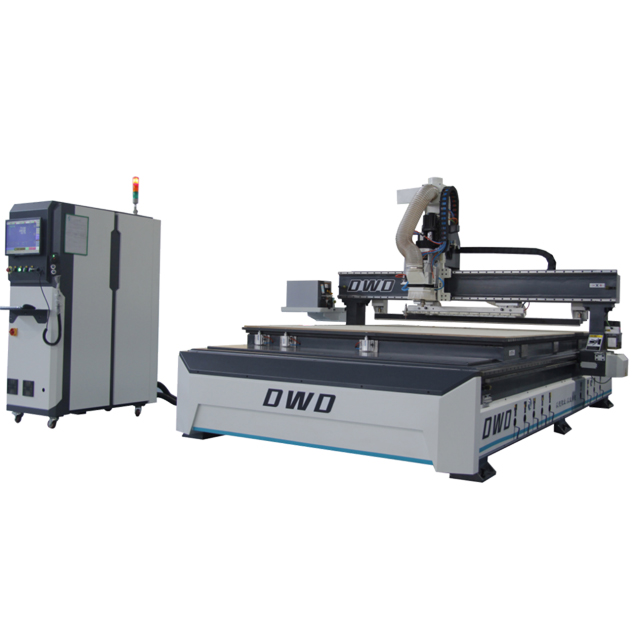
At the heart of this setup is the vacuum hold-down architecture. A high-performance automatic labeling nesting CNC router employs a porous MDF spoilboard over a grid matrix. High-capacity pumps draw air through this board. This creates a uniform suction that anchors the entire panel firmly. Modern units often feature a robust 9kW air-cooled spindle paired with high-speed 850W servo motors. This combination ensures stable, high-precision passes for drilling, dados, and cutting modular cabinetry.
In contrast to the flat-table approach, pod-and-rail technology embraces a completely different mechanical philosophy. Instead of a solid surface, this system utilizes heavy-duty rails equipped with movable vacuum cups. By elevating the workpiece, the machine grants the cutting tool unobstructed access to the edges and underside of the material. This clearance is absolutely critical for horizontal edge-boring, deep profiling, and complex furniture joinery.
While the industry trends heavily toward automation for flat panels, the demand for high-end custom millwork keeps the pod-and-rail system highly relevant. It remains the go-to solution for shops focused on crafting intricate staircase components or solid wood doors. Furthermore, many modern versions feature dual-zone processing. An operator can stage blanks on one side while the machine actively mills on the other. This effectively eliminates machine idle time.
Feature | Nesting CNC Router | Pod-and-Rail CNC |
|---|---|---|
Best For | Cabinetry, panel processing, flat-pack furniture | Solid wood doors, stairs, complex joinery |
Material Yield | Maximum yield via optimized CAM layouts | Requires pre-cut blanks causing higher waste on sheet goods |
Edge Access | Limited to top and vertical drilling | Full access to edges and underside |
Automation Potential | High. Easy integration with loading and unloading | Moderate. Often requires manual staging |
Setup Time | Minimal. Software handles the layout | Higher. Requires manual pod placement per job |
When evaluating throughput, shop owners must distinguish between raw volume and operational flexibility. For high-volume production of standardized sheet goods, a flat-table setup is undeniably faster. An operator loads a sheet, hits start, and the machine handles the rest of the cycle without manual intervention. Material costs remain a massive expense for any woodworking facility. Nesting software is engineered around the physics of the kerf. It groups parts mathematically to leave only a few millimeters of space between them. This precise extraction minimizes dumpster waste and directly boosts your bottom line.
Conversely, productivity takes a different shape when your order list comprises one-off custom pieces. A pod-and-rail system requires you to pre-cut materials into rough blanks. While this seems like an extra step, it offers a distinct advantage when working with expensive exotic hardwoods. Operators can manually inspect grain patterns and avoid natural defects before mounting the material. Automated software simply cannot replicate this level of artisanal control.
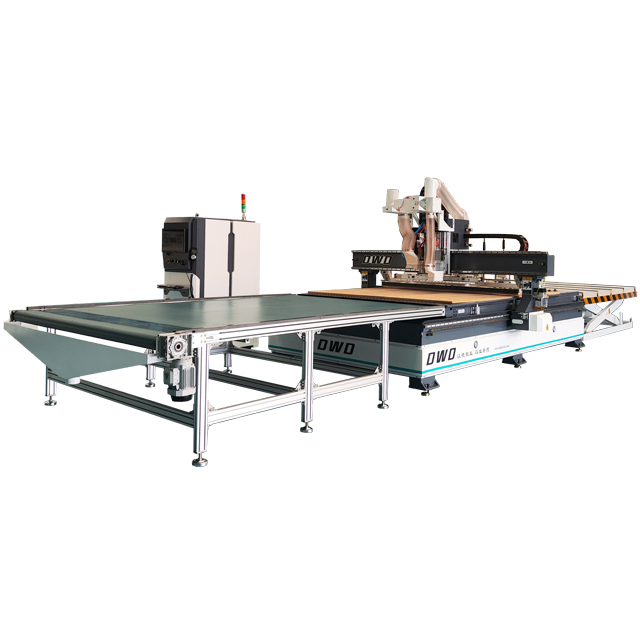
As labor shortages challenge the manufacturing sector, automation has shifted from a luxury to a competitive necessity. We are seeing rapid adoption of integrated manufacturing cells on the shop floor. Specifically, integrating an automatic labeling CNC router machine redefines production speed. By applying barcodes before the cutting process, shops ensure every downstream operation is tracked. Edgebanding, drilling, and assembly become seamlessly linked to the master job file.
Beyond labeling, these advanced systems utilize hydraulic scissor lifts and motorized conveyor belts. Finished parts are cleared in seconds. This move toward a lights-out manufacturing environment allows machines to run continuously. While pod-and-rail systems are evolving, their inherent manual setup requirements make continuous hands-off automation much more difficult to achieve.
Integrating industrial machinery into your existing floor plan requires a realistic look at your facility utilities. A dedicated nesting line requires a substantial linear footprint. You must account for the machine itself and the forklift space needed to maneuver full bunks of material.
In addition, the vacuum requirements for flat-table systems are significant. High-capacity pumps generate considerable noise and heat. You might need to construct a sound-insulated utility room. Dust collection is another critical infrastructure factor. Because the bit is trapped within the kerf of a sheet, these machines require high-velocity extraction to prevent tool burning. Pod-and-rail systems generally operate with a more open profile, allowing dust to fall away naturally.
Determining your Return on Investment involves balancing initial capital expenditure against long-term labor savings. How do you make the final call? Look at your daily production data.
If your shop processes 20 to 50 sheets of melamine or plywood per day for frameless cabinets, a flat-table router is your clear winner. It condenses what used to take 30 hours on a sliding table saw into a single high-output shift. If your revenue comes from high-end custom solid wood joinery, arched window frames, or five-piece doors, force-fitting those parts onto a flat table will cause frustrating workarounds. The precision-milled aluminum rails and pneumatic manifolds of a pod-and-rail system will pay for themselves through superior edge profiling capabilities.
Ultimately, there is no single correct choice. There is only the choice that best serves your current business trajectory. Shops focusing on cabinetry and high-volume panel processing will find a flat-table system to be the ultimate catalyst for growth. Shops that thrive on the artistry of custom non-standard woodworking will find the flexibility of elevated pods indispensable.
Ready to upgrade your production line? Audit your current order volume and explore high-performance equipment that fits your exact needs. Discover the ideal nesting CNC router machine for cabinet making from DWD CNC to transform your shop into a highly profitable, efficient operation.
Yes, but it is primarily optimized for sheet goods. You can process solid wood on a flat spoilboard, but you lose the advantage of edge access that elevated pods offer for complex joinery.
Most modern systems come with intuitive CAM software. This software handles automatic part layouts mathematically. It significantly minimizes the learning curve for operators comfortable with basic computer operation.
The vacuum pump is critical for creating the seal that holds your sheet material firmly against the spoilboard. Without consistent high-flow vacuum pressure, small parts will shift during the cutting process. This leads to ruined materials and safety hazards.
Generally, no. While you can add flat table attachments to some systems, they lack the specific high-flow vacuum manifold design required to achieve the extreme hold-down pressure of a dedicated flat-table router.
A standalone machine requires about 15 by 10 feet. However, a fully automated line with a hydraulic loading lift and unloading conveyor often requires a linear footprint of 30 to 40 feet. You must also leave adequate aisles for forklift access.
Flat-table systems require frequent resurfacing of the MDF spoilboard to maintain vacuum integrity. Pod-and-rail systems require regular cleaning of the pneumatic manifolds and replacement of the rubber vacuum pod seals as they wear out over time.