close
Choose Your Site
Global
Social Media

Views: 0 Author: Site Editor Publish Time: 2026-11-16 Origin: Site
Manual carving holds undeniable traditional charm. Yet, it severely bottlenecks your creative output and shop floor production speed. Today, digital fabrication bridges the frustrating gap between artistic intent and sheer manufacturing volume. I have seen small weekend shops transform into high-throughput production facilities simply by adopting the right routing technology. In this guide, we will break down exactly what modern CNC technology can do, the actual physics of cutting, and how it can permanently upgrade your workshop capabilities.
Mechanical Versatility: Modern routing systems extend far beyond basic flat panel processing, utilizing multi-axis movements to mill intricate three-dimensional geometries.
Profitable Niches: Custom cabinetry, architectural signage, and personalized decor represent high-margin opportunities that outpace mass-produced imports.
Technical Optimization: Shop floor success depends heavily on selecting the correct carbide tooling, optimizing software toolpaths, and managing chip loads.
Scalability: Transitioning to industrial production requires specific heavy-duty features like 9kW spindles, automatic tool changers, and rigid welded steel frames.
The core advantage of computer numerical control technology is raw mechanical adaptability. Traditional hand tools rely entirely on physical templates and human muscle memory. In contrast, a digital routing system operates on rigid Cartesian coordinates across the X, Y, and Z axes. This precision engineering allows operators to hit tolerances tighter than a fraction of a millimeter, every single time.
Standard three-axis machines move the cutting spindle left-to-right, front-to-back, and up-and-down. Furthermore, advanced industrial systems often incorporate a fourth rotary axis to turn the workpiece itself. Imagine chucking a raw block of walnut and watching it transform into a perfectly symmetrical, fluted table leg in under ten minutes. This continuous carving of cylindrical objects vastly expands the operational scope of a standard cabinet shop.
Material compatibility dictates your product range. While solid hardwoods and softwoods behave predictably, these systems are engineered to dominate sheet goods and composites.
Material Type | Machining Characteristics | Common Shop Applications |
|---|---|---|
Medium-Density Fiberboard | Highly stable with no grain direction. Produces highly abrasive fine dust. | Painted cabinet doors, spoilboards, architectural wall panels. |
Baltic Birch Plywood | Strong distinct edge layers. Requires sharp compression bits to prevent veneer tear-out. | Flat-pack furniture, structural frames, shop jigs. |
Solid Woods like Oak and Walnut | Variable density. Requires careful grain orientation and specific feed rate adjustments. | High-end bespoke furniture, relief carvings, heavy tabletops. |
Composites and Plastics | Extremely heat sensitive. Requires aggressive chip loads to prevent the material from melting to the bit. | Storefront signage, custom inlays, mechanical wear parts. |
The capabilities of this technology extend well beyond two-dimensional profiling. By varying the depth of the Z-axis in minute increments simultaneously with the X and Y axes, fabricators execute stunning three-dimensional relief carving. This process transforms a flat piece of stock into a highly textured surface, replicating the look of traditional hand-carved sculptures with absolute repeatability.
Current industry data shows a massive pivot within the furniture manufacturing sector. Supply chain volatility and a severe, persistent shortage of skilled cabinet makers are forcing shop owners to automate. Consumers now demand sustainable, locally produced flat-pack furniture rather than waiting months for overseas shipping. This aggressive shift toward localized, on-demand manufacturing makes advanced routing equipment the absolute cornerstone of modern shop resilience.
The transition from manual joinery to digital furniture fabrication requires a distinct shift in design philosophy. A rotating cylindrical bit simply cannot cut a perfectly sharp internal corner. Consequently, operators utilize specialized design techniques for modular building. The most common workaround is the dogbone fillet, where the toolpath slightly overcuts the inside corners of a mortise. A square tenon then fits perfectly into the slot without any manual chiseling required.
Batch production is where digital fabrication demonstrates its highest commercial value. Cutting twenty identical cabinet sides manually introduces a high margin for human error and fatigue. A digital system eliminates this variance entirely. Once you verify the prototype program, the equipment replicates exact dimensions indefinitely.
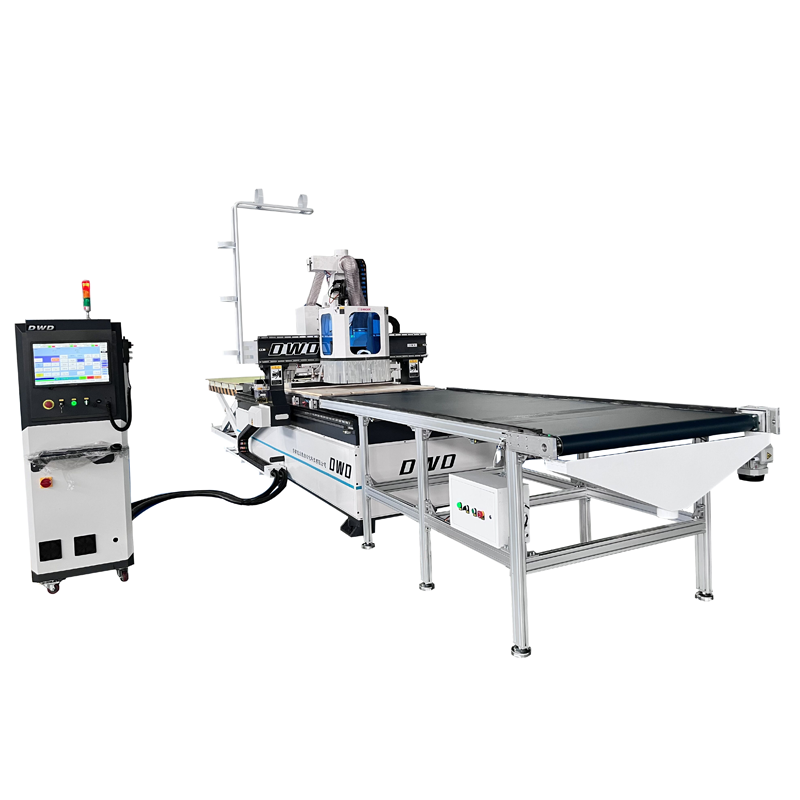
For workshops aiming to scale their output, automated material handling is essential. Machining both sides of a heavy cabinet panel manually is a nightmare for alignment. Investing in a professional woodworking CNC router machine equipped with an auto-flip mechanism processes the front and back of a panel seamlessly. This eliminates the back-breaking labor of flipping heavy sheets and ensures flawless alignment for complex joints and hardware mounting holes.
Structural furniture pays the bills, but routing technology also dominates the decorative arts sector. Precision and intricate detailing are non-negotiable here. Architectural wall panels and decorative privacy screens serve as prime examples. By utilizing algorithmic design software, makers generate parametric wave patterns or complex geometric lattices that would be nearly impossible to carve by hand consistently.
Signage and branding represent another major revenue stream. Businesses prioritize routed signage because it offers depth and tactile appeal that flat-printed signs completely lack. When setting up a V-carve toolpath for a storefront sign, the bit dynamically raises and lowers at the corners of serif fonts. This simultaneous movement yields crisp, chiseled points that look incredibly professional.
In the realm of custom home decor, personalization creates a massive value proposition. Fabricators frequently produce cutting boards featuring engraved family names, epoxy-filled inlays, and topographical maps carved into solid wood centerpieces. These bespoke items command premium retail prices yet require minimal active labor once you press cycle start.
The commercial upside of digital woodworking is substantial, provided you run it like a structured business rather than a hobby. The secret to profitability is identifying niche markets where mass-produced, injection-molded plastics fail to meet consumer demands. Modern customers gladly pay a premium for personalization, localized themes, and high-quality solid materials.
Calculating accurate profit margins is critical to keeping your shop doors open. You must factor in much more than just the cost of the raw timber. A comprehensive pricing model includes material costs, carbide tooling wear, electricity, finishing labor, and the hourly operational amortization rate of the equipment itself.
Product Type | Est. Material Cost | Machine Time | Finishing Labor | Typical Retail Price | Profit Potential |
|---|---|---|---|---|---|
Custom V-Carved Sign | $15.00 | 25 mins | 30 mins | $120 - $180 | High |
Flat-Pack Plywood Desk | $60.00 | 45 mins | 20 mins | $250 - $400 | Medium-High |
3D Topographical Map | $40.00 | 4 hours | 45 mins | $300 - $600 | High but Machine Intensive |
Engraved Coaster Set | $5.00 | 15 mins | 10 mins | $35 - $50 | Medium Volume Dependent |
Marketing these creations effectively often involves showcasing the manufacturing process itself. The visual appeal of a spindle precisely shearing away material is highly engaging on social media platforms. By sharing time-lapse videos of the cutting process alongside the finished product, businesses build a loyal audience and demonstrate the exact craftsmanship that justifies their premium pricing.
You need to understand the digital pipeline to fully grasp what you can produce. A router is just dumb iron without proper instructions. The workflow splits into three distinct phases: Computer-Aided Design, Computer-Aided Manufacturing, and physical finishing.
The design phase is where your project begins. Using vector software or 3D modeling platforms, designers create mathematical paths that dictate the exact dimensions of the part. For a beginner, this might involve drawing a simple two-dimensional outline of a tray. For an advanced engineer, this step involves modeling complex, interlocking components for modular commercial cabinets.
Once the design is locked in, it moves into the manufacturing software. This acts as the brain behind the machining operations. Here, the operator assigns specific toolpaths to the vector lines, dictating which router bit to use, plunge depth, feed rate, and spindle RPM. The software then translates these instructions into G-code. When processing nested sheets of plywood, a reliable woodworking CNC router machine reads these complex coordinates and executes fluid, precise physical movements.
Toolpath optimization is a critical shop skill that separates novices from profitable professionals. Efficient programming minimizes wasted air cutting and utilizes appropriate stepovers. By employing nesting strategies, operators arrange multiple parts onto a single sheet of material, minimizing expensive waste and maximizing yield.
Toolpath Type | Primary Application | Engineering Description |
|---|---|---|
Profile Cut | Cutting out shapes | The bit follows the inside, outside, or center of a vector line to sever a part from the raw stock. |
Pocketing | Recessing areas | The machine clears material inside a closed vector boundary to a specific depth. Excellent for hardware recesses. |
V-Carving | Lettering and signs | Uses an angled bit that varies its Z-depth to create sharp corners and tapered edges. |
3D Roughing | Bulk material removal | A fast, aggressive toolpath that hogs out the bulk of the material before detailed carving begins. |
3D Finishing | Intricate relief carving | A slow, high-resolution pass using a ball-nose bit to create smooth topographical surfaces. |
Finally, the physical finishing begins. While a well-calibrated setup leaves a relatively clean edge, secondary processing is mandatory for a retail-ready look. Progressing through sandpaper grits, applying wood conditioners, and spraying durable polyurethane topcoats are necessary steps to give the machined parts a professional appearance.
Your machine is only as good as the spinning carbide attached to the spindle. Selecting the correct router bit and implementing robust workholding strategies are fundamental to achieving precise cuts and maintaining a safe shop environment.
Router bits come in various shapes, sizes, and flute configurations. The geometry of these flutes determines exactly how the wood chips are ejected and how the wood fibers are sheared.
Up-cut Spiral Bits: These pull the wood chips upward, clearing the cutting path efficiently. They are excellent for deep pocketing but will cause severe splintering on the top surface of veneered plywood.
Down-cut Spiral Bits: These push the chips downward, leaving a pristine, tear-free top edge. However, because the chips are compressed into the cut, they require slower feed rates to prevent friction fires.
Compression Bits: This is the industry standard for cabinet makers. The dual-action geometry shears the top fibers down and the bottom fibers up. Consequently, it leaves a flawless edge on both sides of double-sided melamine or veneer.
Ball Nose Bits: Featuring a rounded tip, these are used almost exclusively for three-dimensional relief carving and creating smooth topographical transitions.
V-Bits: Angled bits used for lettering, chamfering, and sharp corner detailing.
Workholding strategies are equally critical. If a workpiece shifts by even a fraction of a millimeter during a heavy cut, the entire piece is ruined. Hobbyist setups often rely on T-slot tracks and mechanical cam clamps. In a real production environment, clamps are a massive collision hazard for the spindle. Industrial vacuum beds are the standard. A high-powered vacuum pump draws air through a porous spoilboard, creating immense suction that holds the material flat and rigid. This allows for edge-to-edge cutting without physical interference.
Safety standards cannot be compromised on the shop floor. High spindle speeds generate fine particulate dust, particularly when cutting engineered boards containing formaldehyde resins. A dedicated dust collection system with a high CFM rating and HEPA filtration is a critical health requirement. Operators must also utilize proper impact-rated eye protection and familiarize themselves with easily accessible emergency stop buttons.
Whether you are a weekend hobbyist or an entrepreneur aiming to scale a furniture brand, selecting the right equipment dictates your absolute production ceiling. Do not buy a lightweight aluminum extrusion machine if you plan to cut thick Baltic birch all day. You will experience severe chatter, tool deflection, and ruined parts. You need mass and rigidity.
Industrial machines are built with heavy cast-iron or welded steel frames. They utilize closed-loop servo motors, which provide real-time feedback to the controller. This ensures the system never loses its positional accuracy, even when plowing through dense hardwoods at high feed rates.
When evaluating equipment for commercial use, look closely at these specific engineering parameters:
Spindle Power: A standard hobby spindle might be 1.5 kW, requiring multiple shallow passes to cut through plywood. An industrial 9 kW air-cooled electro-spindle slices through that same material in a single, rapid pass.
Automatic Tool Changer: In complex cabinet projects, you need an end mill for profiling, a V-bit for engraving, and a boring bit for shelf pins. A system with a 12-slot linear automatic tool changer swaps these bits in seconds, drastically reducing your production cycle times.
Advanced Automation: For businesses focused on high-efficiency furniture manufacturing, specialized automation is a game-changer. Upgrading to a professional auto-flip woodworking CNC router machine enables the system to process both sides of a cabinet panel without manual flipping. Combined with automatic loading and unloading tables, this transforms a two-man bottleneck into a single-operator continuous workflow.
Purchasing equipment is a long-term capital investment. The specifications on paper are only half of the equation. The reliability of the manufacturer is equally vital. Selecting a provider that offers robust technical support, readily available replacement parts, and comprehensive training ensures that a minor mechanical issue does not result in weeks of costly production downtime.
Feature | Entry-Level Hobbyist | Professional Industrial |
|---|---|---|
Frame Construction | Bolted Aluminum Extrusion | Heavy Welded Steel or Cast Iron |
Drive System | Open-Loop Stepper Motors | Closed-Loop AC Servo Motors |
Spindle Power | 1.5 kW to 2.2 kW | 9.0 kW to 12.0 kW Electro-spindle |
Tool Changing | Manual Collet Wrench | Linear or Carousel Automatic Tool Changer |
Workholding | T-Tracks and Mechanical Clamps | Multi-Zone Vacuum Matrix Table |
A digital routing system transforms digital designs into physical reality with breathtaking precision and speed. Ultimately, your creativity and software skills are the only true limits to what you can produce. By starting with simple designs to master the operating software, you can steadily scale production as your woodworking business grows. Ready to upgrade your shop floor? Evaluate your production bottlenecks and explore the industrial-grade solutions at DWD CNC to find the exact woodworking CNC router machine tailored to your manufacturing goals.
The physical operation of the equipment is relatively straightforward. The true learning curve lies entirely in the design and manufacturing software. Beginners must learn how to think in vectors, understand tooling geometry, and grasp how feed rates affect material removal. Fortunately, modern software interfaces have become highly intuitive. Most dedicated beginners can comfortably design and cut simple two-dimensional projects within their first few weeks of consistent practice.
Profitability generally comes from items with high perceived value and low material costs. Custom signage for local businesses, personalized wedding decor, and bespoke topographic maps are highly lucrative. Additionally, flat-pack modular furniture offers excellent margins. A single sheet of plywood can be transformed into a high-end designer chair with minimal manual labor, maximizing your hourly shop rate.
For general woodworking and sign making, Vectric VCarve Pro is the industry standard due to its user-friendly interface. For complex, parametric furniture design and 3D modeling, Autodesk Fusion 360 is highly recommended. Cabinet shops focused on high-volume sheet goods often rely on specialized nesting software like Mozaik or Cabinet Vision, which automatically generate cut lists and optimized toolpaths for entire kitchen builds.
Industrial routers require strict preventative maintenance. Daily tasks include blowing off dust from the linear rails and ensuring the spindle collet is free of debris. Weekly maintenance involves greasing the linear guide blocks and checking the tension on the rack and pinion drives. You must also regularly surface your MDF spoilboard to ensure the vacuum table remains perfectly flat relative to the spindle.
Yes, a rigid and well-calibrated system is highly versatile. Beyond solid woods and plywood, these routers frequently machine plastics like acrylic, polycarbonate, and high-density polyethylene. With the correct feed rates, specialized single-flute bits, and a cooling lubricant mist, professional-grade routers can also precision-cut soft non-ferrous metals such as aluminum, brass, and copper.
The time required is drastically lower than traditional manual woodworking. Once the digital design is finalized, the actual cutting time for a standard piece of furniture usually takes between 15 to 45 minutes on an industrial machine. The true time-saving benefit comes from automation and repeatability. A digital system cuts perfectly aligned mortises, tenons, and profiles simultaneously, reducing final assembly time to mere minutes.